Canon EOS R6 Mark III vs Nikon Z6 III • Which one is better?
Canon EOS R6 Mark III vs Nikon Z6 III • Which One Is Better?
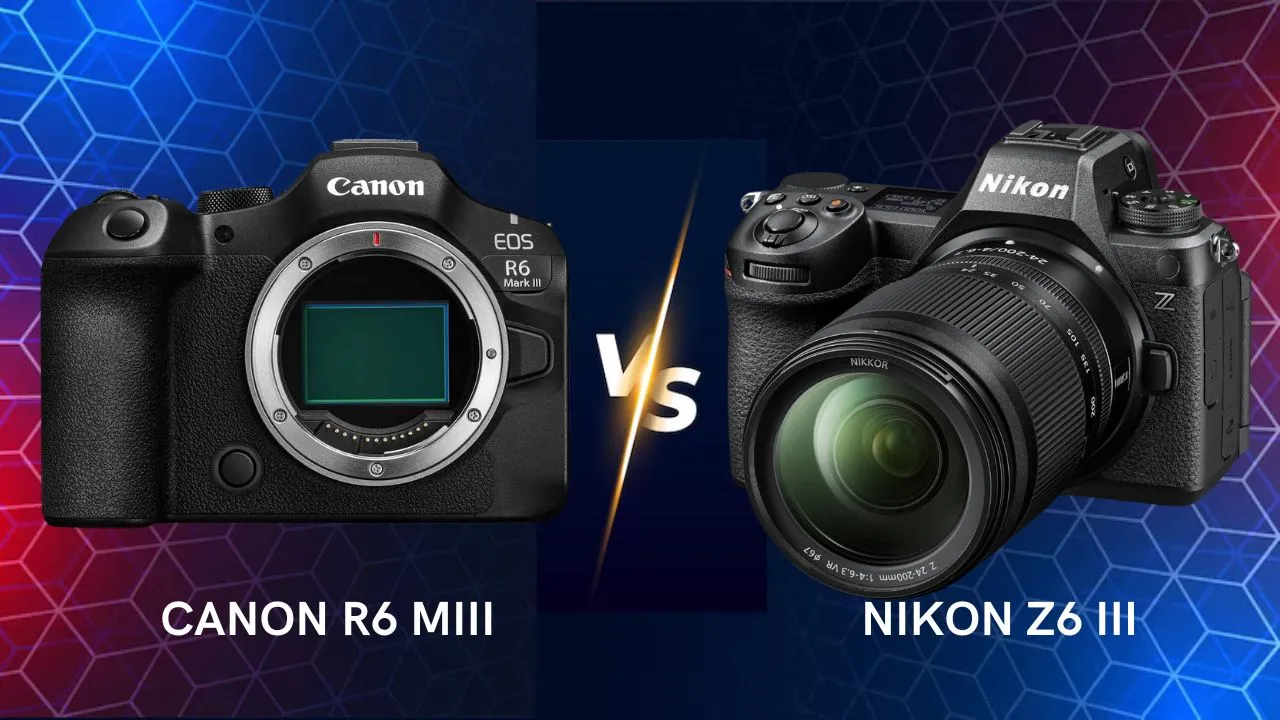
The Canon EOS R6 Mark III and the Nikon Z6 III are two of the most exciting mid-range full-frame hybrid cameras of 2024. Both aim to deliver professional-level performance in a compact, affordable package — balancing high-end specs, excellent autofocus, and advanced video capabilities.
While Canon focuses on refined hybrid performance with 7K RAW and advanced AI autofocus, Nikon has upped its game with the Z6 III — the world’s first partially stacked full-frame CMOS sensor, offering incredible readout speeds and stunning 6K video.
So, between the Canon R6 Mark III and Nikon Z6 III, which one is better for you? Let’s break it down.
⚙️ Overview – Hybrid Power vs Next-Gen Speed
Canon EOS R6 Mark III:
Canon’s latest full-frame hybrid camera, featuring a 32.5 MP sensor, DIGIC X processor, in-body stabilization up to 8.5 stops, and 7K RAW video. It’s designed for professionals and hybrid creators who demand both cinematic video and detailed stills.
Nikon Z6 III:
Nikon’s high-speed full-frame hybrid with a 24.5 MP partially stacked CMOS sensor, EXPEED 7 processor, blazing-fast autofocus, and oversampled 6K video. It’s built for creators who value speed, color science, and versatile hybrid workflows.
In short:
-
R6 Mark III = Higher resolution, 7K RAW, and Canon’s color science.
-
Z6 III = Faster readout, advanced video pipeline, and exceptional autofocus.
📸 Specifications Comparison
| Feature | Canon EOS R6 Mark III | Nikon Z6 III |
|---|---|---|
| Release Date | 2025 | 2024 |
| Camera Type | Full-Frame Mirrorless (Hybrid) | Full-Frame Mirrorless (Hybrid) |
| Sensor | 32.5 MP Full-Frame CMOS | 24.5 MP Partially Stacked Full-Frame CMOS |
| Processor | DIGIC X | EXPEED 7 |
| Lens Mount | Canon RF | Nikon Z |
| ISO Range | 100–64,000 (50–204,800 expanded) | 100–64,000 (50–204,800 expanded) |
| Dynamic Range | Up to 15 stops (CLog2) | Up to 14.5 stops (N-Log / HLG) |
| In-Body Stabilization (IBIS) | ✅ Up to 8.5 stops | ✅ Up to 8 stops |
| Autofocus System | Dual Pixel CMOS AF II (R1-level AI) | 273-point Hybrid AF with Deep Learning |
| AF Detection | Humans, Animals, Vehicles | Humans, Animals, Vehicles |
| AF Working Range | EV -6.5 to 21 | EV -10 to 20 |
| Continuous Shooting | 12 fps (Mech), 40 fps (Elec) | 14 fps (Mech), 60 fps (Elec, JPEG only) |
| Shutter Speed | 1/8000 (Mech), 1/16000 (Elec) | 1/8000 (Mech), 1/16000 (Elec) |
| Video Recording | 7K 60p RAW Light / 4K 120p / 2K 180p | 6K 60p N-RAW / 5.4K ProRes RAW / 4K 120p |
| Color Profiles | Canon Log 2, Canon Log 3 | N-Log, HLG |
| Color Depth | 10-bit 4:2:2 | 10-bit 4:2:2 |
| Viewfinder | 3.69M-dot OLED (120Hz) | 5.76M-dot OLED (240Hz) |
| Screen | 3” Vari-Angle Touch LCD (1.62M dots) | 3.2” 4-Axis Tilting Touch LCD (2.1M dots) |
| Storage | 1x CFexpress Type B + 1x SD UHS-II | Dual CFexpress Type B |
| Connectivity | Wi-Fi (2.4 & 5GHz), Bluetooth 5.1 | Wi-Fi (2.4 & 5GHz), Bluetooth 5.0 |
| Ports | Mic, Headphone, HDMI Type-A, USB-C | Mic, Headphone, Full HDMI Type-A, USB-C |
| Weather Sealing | ✅ Yes | ✅ Yes |
| Battery | LP-E6P | EN-EL15c |
| USB Charging | ✅ Yes | ✅ Yes |
| Body Material | Magnesium Alloy | Magnesium Alloy |
| Weight (Body Only) | 699 g (25.7 oz) | 740 g (26.1 oz) |
| Price (Body Only) | ~$2,799 / €2,899 (Check on Amazon) | ~$2,499 / €2,799 (Check on Amazon) |
🧱 Build and Handling
Both cameras feature professional-grade builds and weather sealing, with magnesium alloy bodies and deep grips.
The R6 Mark III maintains Canon’s signature ergonomic comfort, with intuitive button placement and a fully articulating screen ideal for video and self-recording.
The Z6 III, however, feels slightly more premium, with a higher-resolution 5.76M-dot EVF at 240Hz — one of the best in its class — and a 4-axis tilting screen (great for both landscape and vertical shooting).
Verdict:
-
R6 Mark III: Excellent ergonomics, classic Canon comfort.
-
Z6 III: More advanced EVF and flexible screen design.
🎯 Autofocus and Performance
Canon’s Dual Pixel CMOS AF II system remains one of the best in the business — fast, accurate, and now enhanced with AI-driven subject detection for humans, animals, and vehicles.
The Z6 III, with Nikon’s deep-learning AF algorithms, matches that precision and offers a wider detection range (down to EV -10), making it more reliable in very dark environments. It also features blazing-fast readout thanks to its partially stacked sensor, reducing rolling shutter during fast action.
Verdict:
-
R6 Mark III: Smarter AF algorithms and exceptional consistency for hybrid work.
-
Z6 III: Faster readout and superior low-light detection.
🎥 Video Capabilities
Both cameras are hybrid monsters, but their approach differs:
Canon EOS R6 Mark III:
-
7K 60p RAW Light (internal)
-
4K 120p with full sensor readout
-
Canon Log 2 / 3 and LUT preview
-
Up to 15 stops DR
-
Waveform, proxy, and pre-record features
Nikon Z6 III:
-
6K 60p N-RAW (internal)
-
5.4K 60p ProRes RAW
-
4K 120p (10-bit)
-
240Hz EVF for seamless monitoring
-
No overheating in long takes
The R6 Mark III wins for sheer resolution flexibility (7K RAW Light) and cinematic control, while the Z6 III stands out for its color pipeline and internal ProRes RAW support — something Canon reserves for higher-end models.
Verdict:
-
R6 Mark III: Best for hybrid pros and cinematic shooters.
-
Z6 III: Best for filmmakers who prefer Nikon’s color science and RAW workflow.
🧠 Image Quality
The R6 Mark III’s 32.5 MP sensor delivers higher detail and greater cropping flexibility, while the Z6 III’s 24.5 MP sensor provides cleaner files, smoother tones, and superior high-ISO performance thanks to its stacked design.
In real-world use, both cameras produce stunning colors and dynamic range, with Canon’s signature warm tones and Nikon’s punchier contrast.
Verdict:
-
R6 Mark III: Higher resolution and better detail for photographers.
-
Z6 III: Cleaner output and slightly better noise control for low light.
🔋 Battery Life and Workflow
Both cameras perform well, with similar endurance and modern USB-C PD charging. The R6 Mark III gains an edge for having both CFexpress + SD slots, allowing flexible workflow, while the Z6 III’s dual CFexpress Type B setup is faster but more expensive.
Thermal management is slightly better on the Nikon, allowing continuous long-form video recording with less heat buildup.
Verdict:
-
R6 Mark III: More flexible workflow and media options.
-
Z6 III: Better thermal stability for extended video sessions.
💰 Price and Value
| Model | Approx. Price | Ideal For |
|---|---|---|
| Canon EOS R6 Mark III | ~$2,799 / €2,899 (Check on Amazon) | Hybrid creators, filmmakers, professionals |
| Nikon Z6 III | ~$2,499 / €2,799 (Check on Amazon) | Hybrid shooters, filmmakers, low-light photographers |
–
The R6 Mark III costs a bit more but offers higher resolution, 7K RAW, and more advanced AI autofocus. The Z6 III gives you stacked-sensor speed and exceptional video quality at a lower price point.
Verdict:
-
R6 Mark III: Best for hybrid creators needing full-frame 7K and pro features.
-
Z6 III: Best for speed, low-light performance, and value.
Check availability and price on Amazon 🛒
📷 Canon EOS R6 Mark III — Amazon USA / Amazon Canada / Amazon UK / Amazon Australia
📷 Nikon Z6 III — Amazon USA / Amazon Canada / Amazon UK / Amazon Australia
Note: camerafight.com participates in the Amazon Associates Program. As an Amazon Associate, we earn from qualifying purchases.
🏁 Final Verdict — Canon R6 Mark III vs Nikon Z6 III
| Type of User | Recommended Camera |
|---|---|
| Professional Photographer | Canon R6 Mark III |
| Filmmaker / Videographer | Nikon Z6 III |
| Hybrid Photo + Video Shooter | Canon R6 Mark III |
| Low-Light / Event Photographer | Nikon Z6 III |
| Travel Creator | Canon R6 Mark III |
| Budget Buyer | Nikon Z6 III |
✅ In short:
Choose the Canon EOS R6 Mark III if you want higher resolution, internal 7K RAW, cutting-edge autofocus, and Canon’s signature color science — perfect for hybrid professionals and creators.
Choose the Nikon Z6 III if you prioritize faster readout, superior EVF, cleaner low-light files, and a smoother video workflow with internal ProRes RAW.
Both cameras are phenomenal hybrids — but while the Z6 III excels in speed and low-light performance, the R6 Mark III offers the better all-round package for creators who demand maximum versatility and cinematic quality.
You may also want to read:
- Canon EOS R6 Mark III vs Canon EOS R6
- Canon EOS R6 Mark III vs Canon EOS R8
- Canon EOS R6 Mark III vs Canon EOS R5
- Canon EOS R6 Mark III vs Canon EOS R6 Mark II
- Canon EOS R6 Mark III vs Canon R5 Mark II
- The Best Lenses for Canon R6 Mark III