Canon EOS R6 Mark III vs Canon R5 Mark II • Which one is better?
Canon EOS R6 Mark III vs Canon EOS R5 Mark II • Which One Is Better?
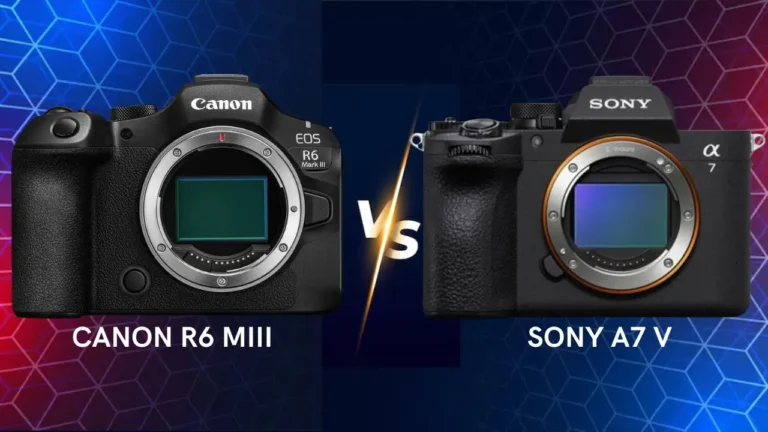
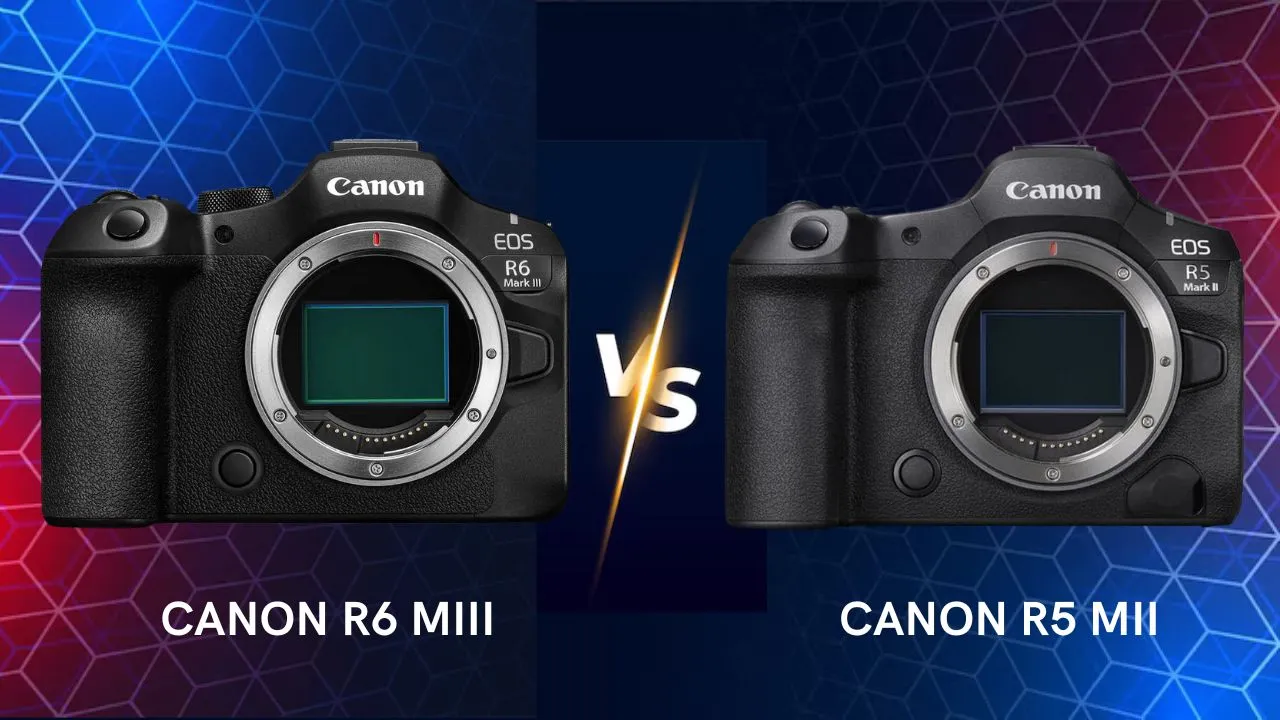
Canon’s mirrorless lineup just got even more exciting – with the arrival of the Canon EOS R6 Mark III, a high-performance full-frame hybrid that sits just below the Canon EOS R5 Mark II, Canon’s new flagship stills and video powerhouse.
At first glance, both cameras look very similar – they share Canon’s refined ergonomics, Dual Pixel CMOS AF II, and professional-grade video specs. But the differences in sensor design, processing power, and target audience are what set them apart.
The R6 Mark III is built as a pro-level hybrid camera for creators, offering impressive speed and cinematic 7K RAW video at a lower price point. The R5 Mark II, meanwhile, is a true flagship – with a stacked sensor, advanced cooling, and uncompromising performance for professionals who need the best Canon has to offer.
So, which one is better for you? Let’s break it down.
(this article contains affiliate links to Amazon)
⚙️ Overview – The Hybrid Workhorse vs The Flagship Powerhouse
Canon EOS R6 Mark III:
A versatile full-frame hybrid camera with a 32.5 MP sensor, 40 fps burst, and internal 7K RAW video. It’s Canon’s most balanced model yet, designed for enthusiasts and professionals who want flagship-level performance without the flagship price.
No products found.
Canon EOS R5 Mark II:
Canon’s top-tier mirrorless camera, featuring a new 45 MP stacked CMOS sensor, DIGIC X2 processor, 8K 60p RAW recording, and faster readout speeds that eliminate rolling shutter. It’s built for demanding pros in photography, cinema, and commercial production.
No products found.
In short:
-
R6 Mark III = Pro-level hybrid for creators and photographers.
-
R5 Mark II = Flagship full-frame camera for professionals who need ultimate performance.
📸 Specifications Comparison
| Feature | Canon EOS R6 Mark III | Canon EOS R5 Mark II |
|---|---|---|
| Release Date | 2025 | 2024 |
| Camera Type | Full-Frame Mirrorless (Hybrid) | Full-Frame Mirrorless (Flagship) |
| Sensor | 32.5 MP CMOS | 45 MP Stacked CMOS |
| Processor | DIGIC X | Dual DIGIC X2 |
| Lens Mount | Canon RF | Canon RF |
| ISO Range | 100–64,000 (50–204,800 expanded) | 100–51,200 (50–102,400 expanded) |
| Dynamic Range | Up to 15 stops (CLog2) | Up to 15+ stops (CLog2) |
| In-Body Stabilization (IBIS) | ✅ 8.5 stops | ✅ 8 stops |
| Autofocus System | Dual Pixel CMOS AF II (R1-level AI) | Dual Pixel CMOS AF II (Next-Gen AI with Deep Learning) |
| AF Detection | Humans, Animals, Vehicles | Humans, Animals, Vehicles, Airplanes, Trains |
| AF Working Range | EV -6.5 to 21 | EV -7 to 21 |
| Continuous Shooting | 12 fps (Mech), 40 fps (Elec) | 20 fps (Elec), 12 fps (Mech) |
| Shutter Speed | 1/8000 (mech) / 1/16000 (elec) | 1/8000 (mech) / 1/16000 (elec) |
| Video Recording | 7K 60p RAW / 4K 120p / 2K 180p | 8K 60p RAW / 4K 120p / 4K 60p HQ |
| Color Profiles | Canon Log 2, Canon Log 3 | Canon Log 2, Canon Log 3, Cinema Gamut |
| Color Depth | 10-bit 4:2:2 | 12-bit RAW / 10-bit 4:2:2 |
| Viewfinder | 3.69M-dot OLED (120Hz) | 5.76M-dot OLED (120Hz) |
| Screen | 3” Vari-Angle Touch LCD (1.62M dots) | 3.2” Vari-Angle Touch LCD (2.1M dots) |
| Storage | 1x CFexpress Type B + 1x SD UHS-II | Dual CFexpress Type B |
| Connectivity | Wi-Fi 5GHz, Bluetooth 5.1, FTP | Wi-Fi 6, Bluetooth 5.3, Ethernet (via adapter) |
| Ports | Mic, Headphone, HDMI Type-A, USB-C | Mic, Headphone, HDMI Type-A, USB-C 3.2 |
| Weather Sealing | ✅ Yes | ✅ Enhanced |
| Battery | LP-E6P | LP-E6NH / LP-E6P |
| USB Charging | ✅ Yes | ✅ Yes (Power Delivery) |
| Body Material | Magnesium Alloy | Magnesium Alloy |
| Weight (Body Only) | 699 g (25.7 oz) | 738 g (26 oz) |
| Price (Body Only) | ~$2,799 / €2,899 (Check on Amazon) | ~$4,299 / €4,499 (check on Amazon) |
🧱 Build and Handling
Both cameras share Canon’s familiar design — a deep grip, intuitive controls, and rugged weather sealing.
The R6 Mark III feels compact yet professional, ideal for hybrid creators who need mobility and durability. The R5 Mark II, slightly heavier, feels more robust and premium, with enhanced cooling vents, dual CFexpress slots, and a larger, sharper EVF.
Verdict:
-
R6 Mark III: Compact, balanced, and pro-friendly.
-
R5 Mark II: Built for long, demanding professional shoots.
🎯 Autofocus and Performance
Both cameras feature Canon’s Dual Pixel CMOS AF II system — but the R5 Mark II introduces a newer AI-based deep learning model for improved subject tracking and recognition across more categories (airplanes, trains, animals, and humans).
The R6 Mark III still delivers elite autofocus performance, inherited from Canon’s R1 algorithm — it’s fast, intelligent, and reliable in low light.
The R5 Mark II’s stacked sensor also means faster readout speeds, making autofocus even more responsive with virtually no blackout or lag.
Verdict:
-
R6 Mark III: Excellent AI AF — fast, natural, and reliable.
-
R5 Mark II: Next-gen AF with more tracking precision and speed.
🎥 Video Capabilities
Here’s where both cameras truly stand out — Canon’s hybrid excellence at two different levels.
Canon R6 Mark III:
-
7K RAW Light up to 60p
-
4K 120p (no crop), 2K 180p slow motion
-
Canon Log 2 / Log 3, 10-bit 4:2:2
-
15 stops of dynamic range
-
Waveform, LUT preview, and proxy recording
-
Pre-record up to 5 seconds
-
Dual card recording and no overheating in normal 4K modes
Canon R5 Mark II:
-
8K RAW up to 60p (12-bit internal recording)
-
4K 120p with full readout and better thermal control
-
Advanced Canon Log 2/3 with cinema color science
-
Active cooling system for unlimited 8K/4K recording
-
Dual CFexpress Type B for high-speed workflows
-
Better rolling shutter suppression (stacked sensor)
Verdict:
-
R6 Mark III: Exceptional hybrid video camera for professionals.
-
R5 Mark II: Industry-level video tool with unmatched resolution and thermal stability.
🧠 Image Quality
The R6 Mark III’s 32.5 MP full-frame sensor provides sharp, clean, and dynamic images with Canon’s signature color science. It’s perfect for photographers who prioritize balance between resolution and low-light performance.
The R5 Mark II steps up with a 45 MP stacked sensor, offering higher resolution and faster readout, resulting in cleaner files, better dynamic range, and virtually zero rolling shutter.
For large prints, commercial work, or demanding color grading, the R5 Mark II clearly leads — but for most creators, the R6 Mark III offers more than enough detail.
Verdict:
-
R6 Mark III: Excellent image quality, optimized for hybrid use.
-
R5 Mark II: Superior resolution, color depth, and detail for professionals.
🔋 Battery Life and Workflow
Both use Canon’s LP-E6 series batteries and offer USB-C charging.
The R5 Mark II has better energy management and cooling, ideal for continuous 8K or 4K recording.
The R6 Mark III remains slightly more efficient for stills and hybrid shooting due to its smaller sensor files.
Dual CFexpress slots on the R5 Mark II also make it better suited for high-speed RAW workflows.
Verdict:
-
R6 Mark III: More efficient and cost-effective.
-
R5 Mark II: Better suited for professional, data-heavy production.
💰 Price and Value
| Model | Approx. Price | Ideal For |
|---|---|---|
| Canon EOS R6 Mark III | ~$2,799 / €2,899 (check on Amazon) | Enthusiasts, hybrid creators, and pros on a budget |
| Canon EOS R5 Mark II | ~$4,299 / €4,499 (check on Amazon) | Professional photographers, filmmakers, and studio users |
–
The R6 Mark III delivers exceptional value — offering flagship-level hybrid performance at nearly $1,500 less.
The R5 Mark II justifies its higher price with cutting-edge tech, a stacked sensor, and 8K recording capability.
Verdict:
-
R6 Mark III: Best value for most professionals.
-
R5 Mark II: Best long-term investment for high-end work.
Check availability and price on Amazon 🛒
📷 Canon EOS R6 Mark III — Amazon USA / Amazon Canada / Amazon UK / Amazon Australia
📷 Canon R5 Mark II — Amazon USA / Amazon Canada / Amazon UK / Amazon Australia
Note: camerafight.com participates in the Amazon Associates Program. As an Amazon Associate, we earn from qualifying purchases.
🏁 Final Verdict — Canon R6 Mark III vs R5 Mark II
| Type of User | Recommended Camera |
|---|---|
| Hybrid Creator / Videographer | Canon R6 Mark III |
| Professional Photographer | Canon R5 Mark II |
| Commercial Filmmaker | Canon R5 Mark II |
| Event / Wedding Photographer | Canon R6 Mark III |
| Studio & Product Work | Canon R5 Mark II |
| Travel Filmmaker | Canon R6 Mark III |
| Budget Buyer | Canon R6 Mark III |
✅ In short:
Choose the Canon R6 Mark III if you want a professional hybrid camera that delivers flagship image quality, 7K RAW video, and outstanding autofocus at a much lower cost.
Choose the Canon R5 Mark II if you demand ultimate performance — 8K RAW, stacked sensor speed, and the highest reliability for professional filmmaking and commercial photography.
Both are outstanding — but the R6 Mark III offers incredible value for hybrid creators, while the R5 Mark II stands as Canon’s ultimate do-it-all full-frame mirrorless camera.
You may also want to read: