Canon EOS R6 Mark III vs Canon EOS R7 • Which one is better?
Canon EOS R6 Mark III vs Canon EOS R7 • Which One Is Better?
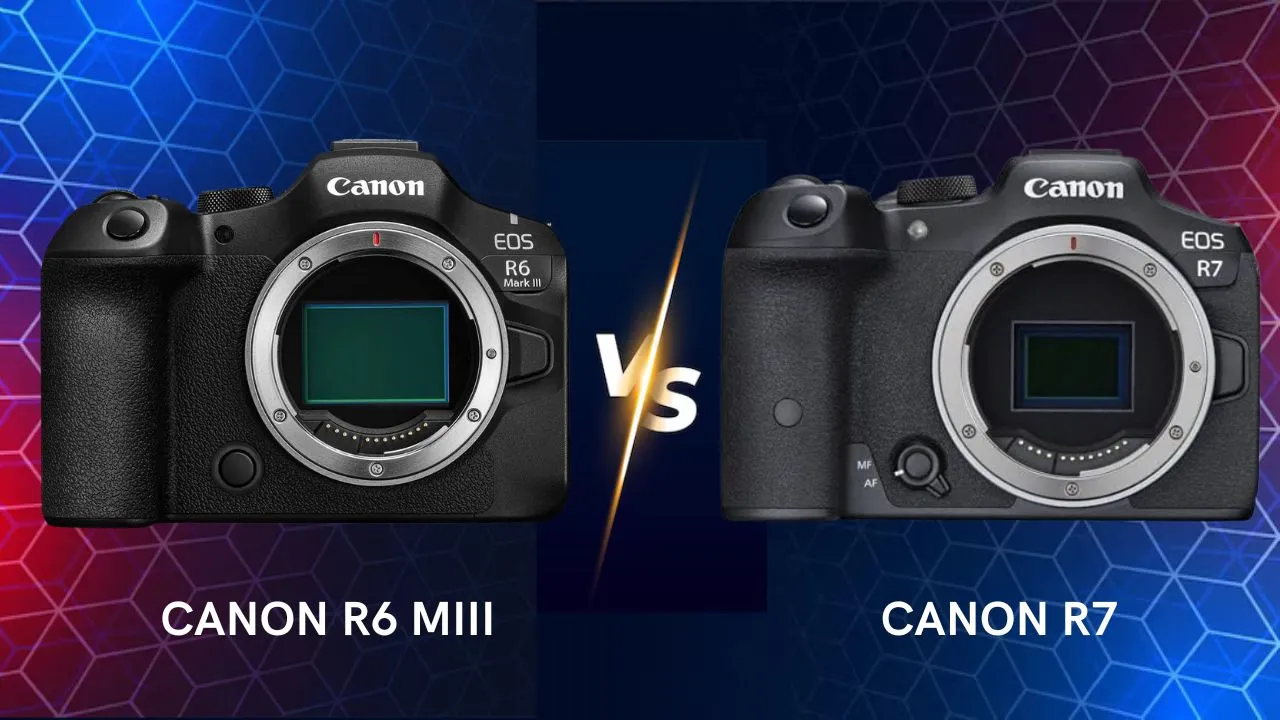
The Canon EOS R6 Mark III and Canon EOS R7 are two powerful mirrorless cameras that sit in the middle of Canon’s mirrorless lineup — one full-frame, one APS-C.
While the R6 Mark III is a hybrid powerhouse aimed at professionals who need the best balance of photo and video performance, the R7 offers incredible speed, reach, and value in a smaller, lighter body.
Both share Canon’s modern design, advanced autofocus, and impressive stabilization, but they’re built for different users. Let’s see which one is right for you.
⚙️ Overview – Full-Frame Power vs APS-C Reach
Canon EOS R6 Mark III:
A professional-grade full-frame camera with a new 32.5 MP sensor, 7K RAW video, and advanced Dual Pixel CMOS AF II inherited from Canon’s flagship models. It delivers exceptional image quality, 40 fps bursts, and up to 8.5 stops of stabilization — perfect for hybrid creators.
Canon EOS R7:
An APS-C powerhouse with a 32.5 MP sensor, 15 fps mechanical burst, and 4K 60p video (oversampled). It’s ideal for wildlife, sports, and travel photographers who want reach and speed at a fraction of the cost.
In short:
-
R6 Mark III = Premium full-frame hybrid camera for professionals.
-
R7 = High-performance APS-C camera for action and wildlife shooters.
📸 Specifications Comparison
| Feature | Canon EOS R6 Mark III | Canon EOS R7 |
|---|---|---|
| Release Date | 2025 | 2022 |
| Camera Type | Full-Frame Mirrorless (Hybrid) | APS-C Mirrorless (Hybrid) |
| Sensor | 32.5 MP Full-Frame CMOS | 32.5 MP APS-C CMOS |
| Processor | DIGIC X | DIGIC X |
| Lens Mount | Canon RF | Canon RF |
| Crop Factor | 1.0x (Full-Frame) | 1.6x (APS-C) |
| ISO Range | 100–64,000 (50–204,800 expanded) | 100–32,000 (51,200 expanded) |
| Dynamic Range | Up to 15 stops (CLog2) | ~13 stops (CLog3) |
| In-Body Stabilization (IBIS) | ✅ Up to 8.5 stops | ✅ Up to 7 stops |
| Autofocus System | Dual Pixel CMOS AF II (AI-driven) | Dual Pixel CMOS AF II |
| AF Detection | Humans, Animals, Vehicles | Humans, Animals, Vehicles |
| AF Working Range | EV -6.5 to 21 | EV -5 to 20 |
| Continuous Shooting | 12 fps (Mech), 40 fps (Elec) | 15 fps (Mech), 30 fps (Elec) |
| Shutter Speed | 1/8000 (Mech), 1/16000 (Elec) | 1/8000 (Mech), 1/16000 (Elec) |
| Video Recording | 7K 60p RAW Light / 4K 120p / 2K 180p | 4K 60p (no crop) / 4K 30p oversampled |
| Color Profiles | Canon Log 2, Canon Log 3 | Canon Log 3 |
| Color Depth | 10-bit 4:2:2 | 10-bit 4:2:2 |
| Viewfinder | 3.69M-dot OLED (120Hz) | 2.36M-dot OLED (120Hz) |
| Screen | 3” Vari-Angle Touch LCD (1.62M dots) | 3” Vari-Angle Touch LCD (1.62M dots) |
| Storage | 1x CFexpress Type B + 1x SD UHS-II | Dual SD UHS-II |
| Connectivity | Wi-Fi (2.4 & 5GHz), Bluetooth 5.1 | Wi-Fi (2.4 & 5GHz), Bluetooth 5.0 |
| Ports | Mic, Headphone, HDMI Type-A, USB-C | Mic, Headphone, Micro HDMI, USB-C |
| Weather Sealing | ✅ Yes | ✅ Yes |
| Battery | LP-E6P | LP-E6NH |
| USB Charging | ✅ Yes | ✅ Yes |
| Body Material | Magnesium Alloy | Polycarbonate + Magnesium Alloy |
| Weight (Body Only) | 699 g (25.7 oz) | 612 g (21.6 oz) |
| Price (Body Only) | ~$2,799 / €2,899 (Check on Amazon) | ~$1,499 / €1,699 (check on Amazon) |
🧱 Build and Handling
Both cameras share Canon’s ergonomic excellence — deep grips, responsive buttons, and intuitive menus.
The R6 Mark III feels more professional, with a fully magnesium-alloy body, full-size HDMI port, and CFexpress slot for faster workflows. It’s also better balanced for larger RF lenses.
The R7 is lighter and smaller, making it perfect for travel and handheld wildlife photography. However, its smaller EVF and micro HDMI port remind you it’s in a lower class.
Verdict:
-
R6 Mark III: Built for professionals and long shooting sessions.
-
R7: Compact, travel-friendly, and easy to carry anywhere.
🎯 Autofocus and Performance
Both use Canon’s Dual Pixel CMOS AF II, but the R6 Mark III inherits the latest AI algorithms from the flagship R1 and R5 Mark II — delivering smarter subject recognition and faster tracking.
The R7 remains excellent for wildlife and sports, with reliable AF and impressive tracking, but it lacks the R6 III’s refined AI-assisted detection and low-light sensitivity (EV -6.5 vs -5).
Verdict:
-
R6 Mark III: Faster, smarter AF with next-gen subject detection.
-
R7: Still excellent, especially for wildlife and sports.
🎥 Video Capabilities
The R6 Mark III is clearly the more advanced hybrid camera. It offers 7K RAW Light, 4K 120p, and Canon Log 2/3, with pro-level tools like waveform monitoring, LUT preview, and pre-recording.
The R7 delivers excellent oversampled 4K 30p and 4K 60p (without crop), making it a capable video camera in its own right — though it lacks 10-bit 120p and internal RAW recording.
Verdict:
-
R6 Mark III: Superior for filmmakers and hybrid creators.
-
R7: Great for casual or budget-conscious video shooters.
🧠 Image Quality
Here’s where the sensor difference really matters.
The R6 Mark III’s full-frame sensor offers better depth of field control, improved low-light performance, and more dynamic range. It also produces cleaner high-ISO images and smoother color transitions.
The R7’s APS-C sensor provides extra reach — your 400mm lens effectively becomes a 640mm — making it excellent for wildlife and sports. However, noise becomes noticeable faster at higher ISOs.
Verdict:
-
R6 Mark III: Better overall image quality and low-light performance.
-
R7: Great for telephoto reach and outdoor shooting.
🔋 Battery Life and Workflow
Both cameras use Canon’s LP-E6 series batteries with similar endurance.
The R6 Mark III adds a CFexpress slot and better thermal control, ideal for long 4K or 7K recording sessions. The R7, meanwhile, benefits from smaller file sizes and lighter workflow, ideal for action or travel photographers.
Verdict:
-
R6 Mark III: Better for heavy hybrid workflows.
-
R7: More efficient and portable for stills.
💰 Price and Value
| Model | Approx. Price | Ideal For |
|---|---|---|
| Canon EOS R6 Mark III | ~$2,799 / €2,899 (Check on Amazon) | Professionals, hybrid creators, filmmakers |
| Canon EOS R7 | ~$1,499 / €1,699 (Check on Amazon) | Enthusiasts, wildlife, and action shooters |
–
The R7 offers incredible value for money — it delivers pro-level performance at nearly half the price of the R6 Mark III.
However, if you need the best in image quality, low-light power, and professional-grade video, the R6 Mark III easily justifies its premium.
Verdict:
-
R7: Best value for wildlife and travel shooters.
-
R6 Mark III: Best hybrid camera for professionals.
Check availability and price on Amazon 🛒
📷 Canon EOS R6 Mark III — Amazon USA / Amazon Canada / Amazon UK / Amazon Australia
📷 Canon R7 — Amazon USA / Amazon Canada / Amazon UK / Amazon Australia
Note: camerafight.com participates in the Amazon Associates Program. As an Amazon Associate, we earn from qualifying purchases.
🏁 Final Verdict — Canon R6 Mark III vs Canon R7
| Type of User | Recommended Camera |
|---|---|
| Professional Photographer | Canon R6 Mark III |
| Wildlife / Sports Shooter | Canon R7 |
| Hybrid Photo + Video Creator | Canon R6 Mark III |
| Travel Photographer | Canon R7 |
| Filmmaker / Videographer | Canon R6 Mark III |
| Budget Buyer | Canon R7 |
✅ In short:
Choose the Canon EOS R6 Mark III if you want full-frame image quality, 7K RAW video, advanced autofocus, and professional-grade hybrid performance.
Choose the Canon EOS R7 if you value portability, telephoto reach, and unbeatable value for wildlife or outdoor photography.
Both cameras are excellent — but the R6 Mark III is the clear choice for professionals and hybrid creators, while the R7 shines as the best budget-friendly performance camera in Canon’s lineup.