Canon EOS R6 Mark III vs Canon EOS R5 • Which Camera Should You Buy?
Canon EOS R6 Mark III vs Canon EOS R5 • Which Camera Should You Buy?
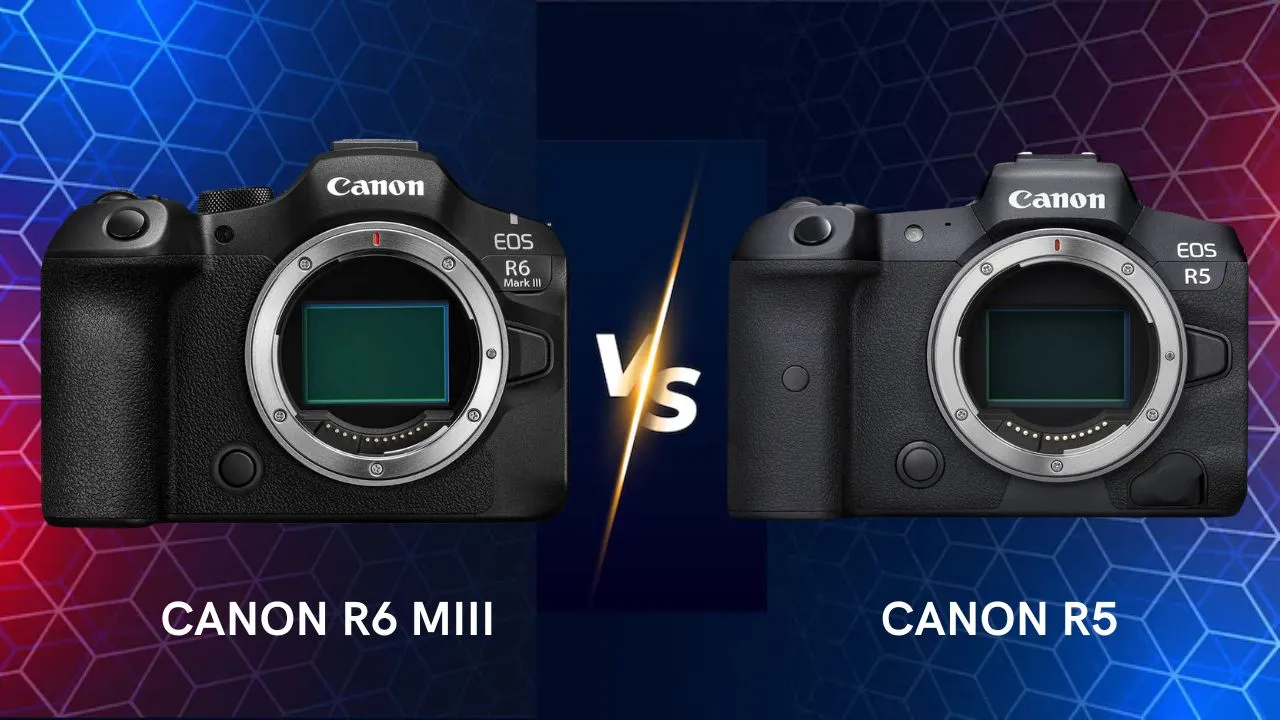
Canon’s mirrorless lineup has become more competitive than ever, and two of its most compelling full-frame hybrids — the Canon EOS R6 Mark III and the Canon EOS R5 — now sit closer than you might expect.
The R6 Mark III is Canon’s newest mid-tier full-frame hybrid, designed to bring many of the R5’s professional features to a lower price point. Meanwhile, the R5 remains one of the most popular and capable hybrid cameras on the market, offering stunning resolution, advanced autofocus, and powerful 8K recording.
At first glance, these two models share a lot: Dual Pixel CMOS AF II, 10-bit 4K video, in-body stabilization, and Canon’s signature ergonomics. But they differ in sensor resolution, recording power, and workflow priorities.
So, which one should you buy? Let’s take a closer look.
⚙️ Overview – High Resolution vs High Versatility
Canon EOS R6 Mark III:
A next-generation hybrid camera featuring a 32.5 MP full-frame sensor, up to 40 fps electronic burst, and internal 7K RAW video. It’s built for hybrid creators and professionals who want cinematic power in a compact, affordable package.
Canon EOS R5:
Canon’s 45 MP full-frame workhorse — still a benchmark for hybrid shooters. It offers 8K RAW recording, 4K 120p video, dual CFexpress card slots, and outstanding photo detail. It’s the go-to body for professionals who need maximum resolution and uncompromising performance.
In short:
-
R6 Mark III = Modern hybrid camera with speed and 7K flexibility.
-
R5 = High-resolution professional camera for detail-oriented photographers and filmmakers.
📸 Specifications Comparison
| Feature | Canon EOS R6 Mark III | Canon EOS R5 |
|---|---|---|
| Release Date | 2025 | 2020 |
| Camera Type | Full-Frame Mirrorless (Hybrid) | Full-Frame Mirrorless (Professional) |
| Sensor | 32.5 MP Full-Frame CMOS | 45 MP Full-Frame CMOS |
| Processor | DIGIC X | DIGIC X |
| Lens Mount | Canon RF | Canon RF |
| ISO Range | 100–64,000 (50–204,800 expanded) | 100–51,200 (50–102,400 expanded) |
| Dynamic Range | Up to 15 stops (CLog2) | Up to 15 stops (CLog3) |
| In-Body Stabilization (IBIS) | ✅ 8.5 stops | ✅ 8 stops |
| Autofocus System | Dual Pixel CMOS AF II (R1-level algorithms) | Dual Pixel CMOS AF II |
| AF Detection | Humans, Animals (Dogs, Cats, Birds, Horses), Vehicles | Humans, Animals, Vehicles |
| AF Working Range | EV -6.5 to 21 | EV -6 to 20 |
| Continuous Shooting | 12 fps (Mech), 40 fps (Elec) | 12 fps (Mech), 20 fps (Elec) |
| Shutter Speed | 1/8000 (Mech), 1/16000 (Elec) | 1/8000 (Mech), 1/8000 (Elec) |
| Video Recording | 7K 60p RAW Light / 4K 120p / 2K 180p | 8K 30p RAW / 4K 120p |
| Color Profiles | Canon Log 2, Canon Log 3 | Canon Log 3, HDR PQ |
| Color Depth | 10-bit 4:2:2 | 10-bit 4:2:2 / 12-bit RAW |
| Viewfinder | 3.69M-dot OLED (120Hz) | 5.76M-dot OLED (120Hz) |
| Screen | 3” Vari-Angle Touch LCD (1.62M dots) | 3.2” Vari-Angle Touch LCD (2.1M dots) |
| Storage | 1x CFexpress Type B + 1x SD UHS-II | Dual CFexpress Type B |
| Connectivity | Wi-Fi (2.4 & 5GHz), Bluetooth 5.1, FTP | Wi-Fi (2.4 & 5GHz), Bluetooth 5.0 |
| Ports | Mic, Headphone, HDMI Type-A, USB-C | Mic, Headphone, Micro HDMI, USB-C |
| Weather Sealing | ✅ Yes (Dust & Moisture Resistant) | ✅ Enhanced Professional Sealing |
| Battery | LP-E6P | LP-E6NH |
| USB Charging | ✅ Yes | ✅ Yes |
| Body Material | Magnesium Alloy | Magnesium Alloy |
| Weight (Body Only) | 699 g (25.7 oz) | 738 g (26.0 oz) |
| Price (Body Only) | ~$2,799 / €2,899 (Check on Amazon) | ~$3,399 / €3,999 (check on Amazon) |
🧱 Build and Handling
The Canon R6 Mark III keeps Canon’s comfortable, professional design — a deep grip, intuitive dials, and balanced layout. It’s slightly lighter and more compact than the R5, making it easier to handle for handheld or gimbal work.
The R5 feels more premium, with a higher-resolution EVF, slightly larger body, and enhanced weather sealing. It’s built to withstand more demanding conditions, especially for professionals shooting events or wildlife.
Verdict:
-
R6 Mark III: Lighter, better suited for hybrid creators and travel.
-
R5: More premium, rugged build for professionals.
🎯 Autofocus and Performance
Both cameras share Canon’s Dual Pixel CMOS AF II system, but the R6 Mark III benefits from newer algorithms derived from the Canon R1. This gives it faster, smarter subject recognition across humans, animals, and vehicles — even in very low light (down to EV -6.5).
The R5 still performs superbly, but its AF system isn’t as advanced in AI subject prediction and tracking behavior. However, the R5’s faster readout speed in electronic shutter (20 fps) makes it highly capable for sports and action.
Verdict:
-
R6 Mark III: Smarter AF with upgraded algorithms and better low-light tracking.
-
R5: Extremely fast, professional-grade AF that remains top-tier.
🎥 Video Capabilities
The biggest difference lies in resolution and format flexibility.
Canon EOS R6 Mark III:
-
7K 59.94p RAW Light (internal)
-
4K 120p (no crop) / 2K 180p
-
Canon Log 2 and Log 3 for up to 15 stops of DR
-
Waveform and LUT preview support
-
Pre-record and proxy options
-
Full-size HDMI Type-A
Canon EOS R5:
-
8K 30p RAW internal (12-bit)
-
4K 120p oversampled from 8K
-
Canon Log 3 and HDR PQ
-
High-quality oversampled 4K modes
-
Dual CFexpress slots for heavy workflows
The R5 still offers the highest resolution and image fidelity, especially for cinema work and high-end productions. The R6 Mark III narrows the gap, though, by providing 7K RAW Light recording — more efficient and thermally stable.
Verdict:
-
R6 Mark III: More efficient, flexible hybrid video solution.
-
R5: Superior image fidelity and 8K resolution for cinema-grade workflows.
🧠 Image Quality
The R5’s 45 MP sensor clearly leads in resolution, ideal for large prints, commercial photography, and heavy cropping. Its files offer rich color depth and impressive dynamic range.
The R6 Mark III’s 32.5 MP sensor hits a sweet spot — detailed enough for professional work, but with smaller file sizes and excellent low-light performance. It also benefits from Canon’s improved color pipeline and better noise control in video.
Verdict:
-
R6 Mark III: Excellent image quality for hybrid creators.
-
R5: Best for photographers who need maximum detail and resolution.
🔋 Battery Life and Workflow
Both use Canon’s LP-E6 series batteries and can be charged via USB-C. The R5’s dual CFexpress slots make it ideal for high-speed RAW workflows, while the R6 Mark III provides more flexibility with its mixed CFexpress + SD configuration.
Thermal management is improved on the R6 Mark III, allowing longer 4K/7K recording without overheating — something early R5 users struggled with before firmware updates.
Verdict:
-
R6 Mark III: More efficient and better thermally balanced for hybrid use.
-
R5: Faster data handling and workflow suited for high-end production.
💰 Price and Value
| Model | Approx. Price | Ideal For |
|---|---|---|
| Canon EOS R6 Mark III | ~$2,799 / €2,899 (Check on Amazon) | Hybrid creators, professionals, and filmmakers |
| Canon EOS R5 | ~$3,399 / €3,999 (Check on Amazon) | High-resolution photographers and cinema professionals |
–
The R5 remains Canon’s higher-end model, but the R6 Mark III offers 90% of its power at a significantly lower cost — with newer autofocus, 7K RAW, and better thermal performance.
Verdict:
-
R6 Mark III: Best value and most balanced option for hybrid creators.
-
R5: Best for professionals who demand top-tier resolution and 8K.
Check availability and price on Amazon 🛒
📷 Canon EOS R6 Mark III —> Amazon USA / Amazon Canada / Amazon UK / Amazon Australia
📷 Canon EOS R5 —> Amazon USA / Amazon Canada / Amazon UK / Amazon Australia
Note: camerafight.com participates in the Amazon Associates Program. As an Amazon Associate, we earn from qualifying purchases.
🏁 Final Verdict — Canon R6 Mark III vs R5
| Type of User | Recommended Camera |
|---|---|
| Hybrid Creator / Videographer | Canon R6 Mark III |
| Professional Photographer | Canon R5 |
| Event / Wedding Shooter | Canon R6 Mark III |
| Landscape or Commercial Photographer | Canon R5 |
| Filmmaker / Cinematographer | Canon R5 |
| Travel / Content Creator | Canon R6 Mark III |
| Budget Buyer | Canon R6 Mark III |
✅ In short:
Choose the Canon EOS R6 Mark III if you want the best balance of performance, portability, and value — with 32.5 MP resolution, 7K RAW video, and Canon’s most advanced autofocus yet.
Choose the Canon EOS R5 if you’re a professional photographer or filmmaker who needs maximum detail, 8K RAW capability, and dual CFexpress slots for demanding production workflows.
Both are exceptional — but the R6 Mark III is Canon’s most versatile hybrid yet, while the R5 remains the benchmark for professionals chasing ultimate image quality.
You may also want to read: