Canon EOS R50 vs Nikon Z30 | Which Camera Should You Buy?
Canon EOS R50 vs Nikon Z30 – Which Camera Should You Buy?
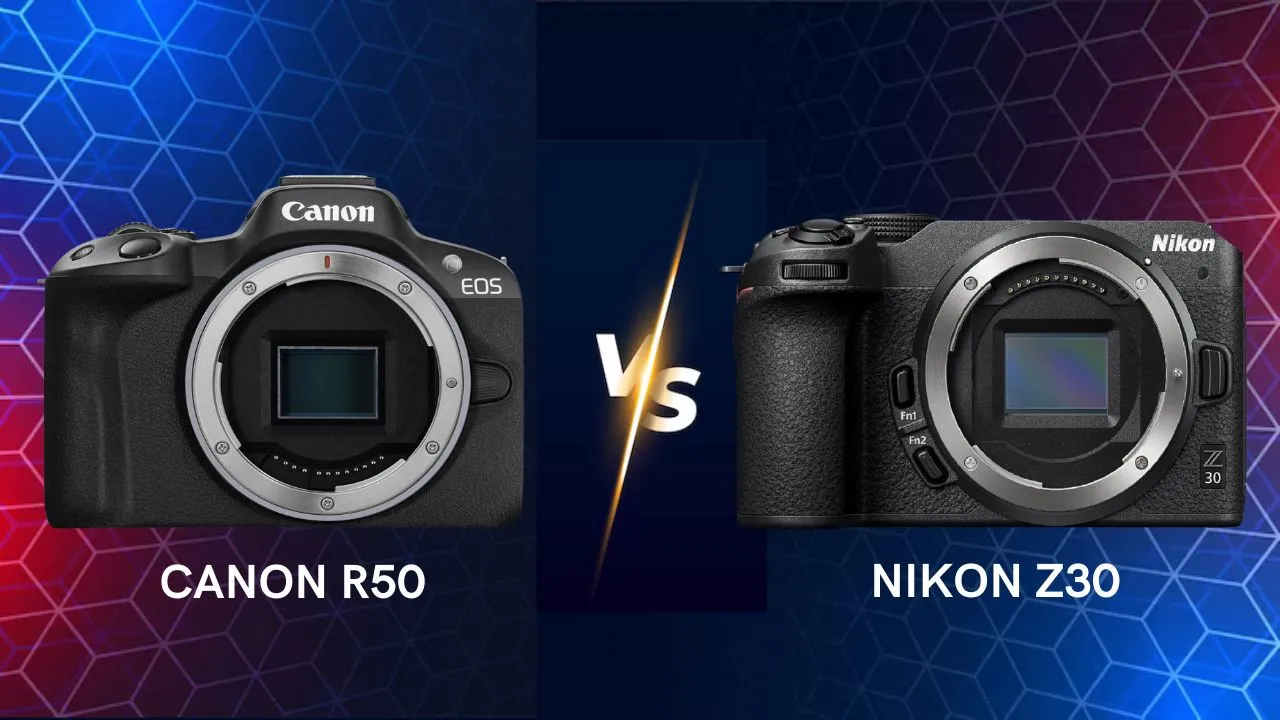
The Canon EOS R50 and the Nikon Z30 are two of the most popular entry-level mirrorless cameras on the market.
Both are compact, beginner-friendly, and designed for creators who want to move beyond smartphone photography or vlogging.
But which one is better suited for you — the Canon R50 or the Nikon Z30?
Let’s compare their design, performance, video capabilities, and value to help you make the right choice.
⚙️ Overview: Two Compact Mirrorless Cameras for Beginners
Both cameras use APS-C sensors and interchangeable lenses, but their goals are slightly different:
-
🎓 Canon EOS R50: Designed for beginners who want an all-around hybrid camera — excellent for both photos and videos.
-
🎥 Nikon Z30: Focused more on vloggers and content creators, offering strong video tools in a small body.
Both are affordable, lightweight, and ideal for anyone entering the mirrorless ecosystem.
📸 Specifications Comparison
| Feature | Canon EOS R50 | Nikon Z30 |
|---|---|---|
| Release Date | February 2023 | June 2022 |
| Camera Type | Mirrorless (Entry-level APS-C, Hybrid) | Mirrorless (APS-C, Vlogging-focused) |
| Sensor | APS-C 24.2 MP CMOS | APS-C 20.9 MP CMOS |
| Image Processor | DIGIC X | EXPEED 6 |
| Lens Mount | Canon RF / RF-S | Nikon Z-mount |
| ISO Range | 100–32,000 (expandable to 51,200) | 100–51,200 (expandable to 204,800) |
| In-Body Image Stabilization (IBIS) | No | No |
| Autofocus System | Dual Pixel CMOS AF II (651 zones) | Hybrid phase-detection AF (209 points) |
| AF Subject Recognition | Humans, animals, birds | Humans, animals (Eye AF via firmware) |
| Continuous Shooting Speed | Up to 12 fps (electronic), 15 fps (electronic shutter) | Up to 11 fps |
| Video Recording | Up to 4K 30p (oversampled from 6K) | Up to 4K 30p |
| Video Bit Depth / Color | 10-bit via HDMI, 8-bit internal | 8-bit internal |
| Color Profiles | Canon Log 3 (via HDMI), HDR PQ | Flat profile |
| RAW Video Output | No | No |
| Recording Limit | No recording limit (thermal dependent) | No recording limit |
| Viewfinder | None | None |
| LCD Screen | 3.0″ fully articulating touchscreen (1.62M dots) | 3.0″ fully articulating touchscreen (1.04M dots) |
| Touch Functions | Yes (AF, tracking, menus) | Yes (AF, menus) |
| Product Showcase Mode | No | No |
| Background Defocus Button | No | No |
| Body Material | Polycarbonate | Polycarbonate |
| Weather Sealing | No | No |
| Audio Options | Mic input | Mic input |
| Connectivity | Wi-Fi, Bluetooth, USB-C, HDMI | Wi-Fi, Bluetooth, USB-C, HDMI |
| Battery Type | LP-E17 | EN-EL25 |
| Battery Life (CIPA) | Approx. 440 shots | Approx. 330 shots |
| Dimensions (W × H × D) | 116.3 × 85.5 × 68.8 mm | 128 × 73.5 × 59.5 mm |
| Weight (Body Only) | Approx. 329 g | Approx. 350 g |
| Price (Body Only) | Approx. USD 680 (check on Amazon) | Approx. USD 710 (check on Amazon) |
🧱 Build and Design
The Canon R50 and Nikon Z30 both feature compact designs perfect for travel and daily use.
However, there’s one major difference:
-
The R50 includes a built-in electronic viewfinder (EVF), great for shooting in bright light.
-
The Z30 omits the EVF to keep the body smaller and lighter, prioritizing portability for vloggers.
Both have a fully articulating touchscreen, making them great for selfies or recording yourself.
The R50 feels slightly more polished, while the Z30 has a minimal, video-oriented design.
👉 Verdict:
-
R50 → Better for photographers who value a viewfinder.
-
Z30 → Better for vloggers who prefer simplicity and compactness.
🎯 Autofocus and Performance
The Canon R50 has a significant advantage here thanks to its Dual Pixel CMOS AF II system — the same autofocus found in Canon’s higher-end R10 and R8.
It offers:
-
Advanced AI-based subject detection (people, animals, vehicles)
-
Excellent eye and face tracking
-
Fast, accurate performance in both photo and video modes
The Nikon Z30 uses a reliable but older 209-point hybrid AF system, which is fast enough but lacks subject recognition AI.
👉 Verdict:
The Canon R50 clearly wins with more intelligent autofocus and faster overall response.
🎥 Video Capabilities
Both cameras deliver solid video specs for creators:
-
Canon R50: 4K 30p (no crop), oversampled from 6K for maximum sharpness, plus Full HD 120p for smooth slow motion.
-
Nikon Z30: 4K 30p (no crop), Full HD 120p, and no 30-minute recording limit, which is a big plus for long takes or streaming.
The Z30 also features a stereo microphone, selfie tally lamp, and flipped-screen recording mode, all designed for vloggers.
However, the R50’s superior autofocus and color science make it more versatile overall.
👉 Verdict:
-
R50 → Better image quality and autofocus for hybrid use.
-
Z30 → Better continuous video and streaming functionality.
📷 Image Quality
The Canon R50’s 24MP sensor provides slightly more resolution and Canon’s well-known color rendering, with beautiful skin tones and natural contrast.
The Nikon Z30’s 20.9MP sensor delivers excellent sharpness and dynamic range, but it’s slightly behind Canon in overall tonal richness.
Both perform well up to ISO 6400, but the R50 has a small edge in detail and JPEG quality straight out of camera.
👉 Verdict:
The Canon R50 offers better color science and overall sharpness.
🔋 Battery Life and Connectivity
Battery life is quite close — around 370 shots for the R50 and 330 shots for the Z30.
Both support USB-C charging, Wi-Fi, and Bluetooth, making file transfer and remote control easy via their companion apps.
The R50 can also connect directly to Canon’s image.canon cloud platform, while Nikon’s SnapBridge app is simple and stable.
💰 Price and Value
Both cameras are competitively priced in the entry-level mirrorless segment:
-
Canon EOS R50: around $679 (body only)
-
Nikon Z30: around $649 (body only)
They both represent excellent value, but the R50’s viewfinder, newer processor, and advanced autofocus make it a better long-term choice for users who want to grow in photography.
Meanwhile, the Z30 remains one of the most appealing cameras for pure vloggers who rarely take still photos.
👉 Verdict:
-
R50: Best all-around hybrid mirrorless camera for beginners.
-
Z30: Best choice for vloggers and YouTubers on a budget.
Check availability and price on Amazon 🛒
📷 Canon EOS R50 — Amazon USA / Amazon Canada / Amazon UK / Amazon Australia
📷 Nikon Z30 — Amazon USA / Amazon Canada / Amazon UK / Amazon Australia
Note: camerafight.com participates in the Amazon Associates Program. As an Amazon Associate, we earn from qualifying purchases.
🏁 Final Verdict – Canon R50 or Nikon Z30?
| Type of User | Recommended Camera |
|---|---|
| Beginner photographer | Canon R50 |
| Hybrid creator (photo + video) | Canon R50 |
| Dedicated vlogger / streamer | Nikon Z30 |
| Traveler / content creator | Canon R50 |
| Long-form video creator | Nikon Z30 |
| Best autofocus system | Canon R50 |
| Best value for YouTube | Nikon Z30 |
✅ In short:
-
Choose the Canon EOS R50 if you want the best autofocus, built-in viewfinder, and strong hybrid performance for both photo and video.
-
Choose the Nikon Z30 if your main goal is vlogging, streaming, or creating YouTube content in a small, lightweight body.
🧠 Final Thoughts
The Canon R50 and Nikon Z30 both deliver excellent performance for beginners and creators stepping into the mirrorless world.
The Canon offers a more advanced autofocus system, better still image quality, and a true hybrid experience.
The Nikon focuses on simplicity and video-first usability, making it ideal for vloggers.
Whichever you choose, both cameras open the door to their brands’ powerful ecosystems — Canon’s growing RF mount or Nikon’s expanding Z lineup — ensuring plenty of creative potential for years to come.
Check also: