Canon EOS R10 vs R100 | Which Camera Should You Buy?
Canon EOS R10 vs Canon R100 – Which Camera Should You Buy?
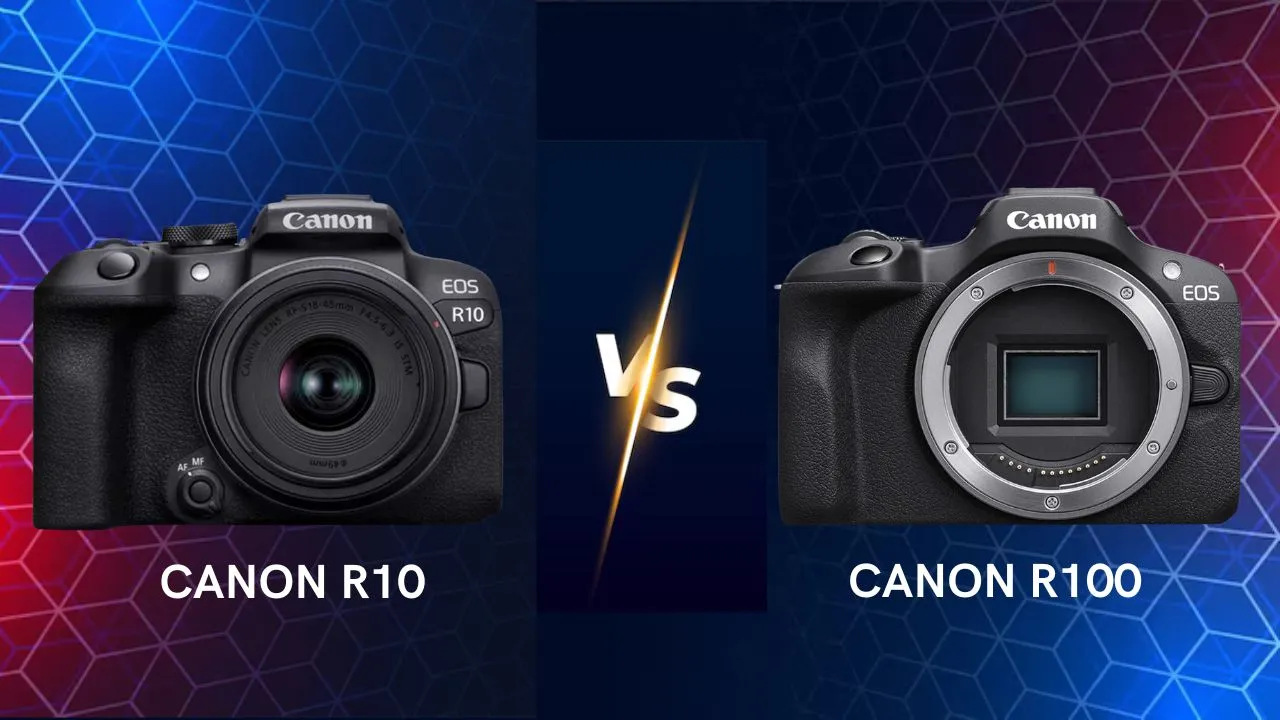
If you’re looking to buy your first Canon mirrorless camera, you’ve probably come across two popular options — the Canon EOS R10 and the Canon R100.
Both use Canon’s RF mount and APS-C sensor, but they serve very different types of photographers.
So, which one is right for you? Let’s break down the key differences in features, performance, and value to help you decide.
⚙️ Overview: Two Cameras, Two Audiences
The Canon R100 is Canon’s most affordable APS-C mirrorless camera — a simple, compact, beginner-friendly model designed for those upgrading from a smartphone or compact camera.
The Canon R10, on the other hand, is aimed at enthusiast photographers and hybrid creators who want faster performance, more control, and advanced autofocus features.
In short:
-
Canon R100 → Basic, affordable, great for learning photography.
-
Canon R10 → Advanced, faster, more versatile for both photos and video.
📸 Specifications Comparison
| Feature | Canon EOS R10 | Canon EOS R100 |
|---|---|---|
| Release Date | May 2022 | May 2023 |
| Camera Type | Mirrorless (Hybrid APS-C) | Mirrorless (Entry-level APS-C) |
| Sensor | APS-C 24.2 MP CMOS | APS-C 24.1 MP CMOS |
| Image Processor | DIGIC X | DIGIC 8 |
| Lens Mount | Canon RF / RF-S | Canon RF / RF-S |
| ISO Range | 100–32,000 (expandable to 51,200) | 100–12,800 (expandable to 25,600) |
| In-Body Image Stabilization (IBIS) | No | No |
| Autofocus System | Dual Pixel CMOS AF II (651 zones) | Dual Pixel CMOS AF (143 points) |
| AF Subject Recognition | Humans, animals, birds, vehicles | Humans (Eye AF only) |
| Continuous Shooting Speed | 15 fps (mechanical), 23 fps (electronic) | 6.5 fps |
| Video Recording | Up to 4K 60p (oversampled from 6K at 30p) | Up to 4K 24p (cropped) |
| Video Bit Depth / Color | 10-bit via HDMI, 8-bit internal | 8-bit internal only |
| Color Profiles | Canon Log 3 (via HDMI), HDR PQ | Standard profiles only |
| RAW Video Output | No | No |
| Recording Limit | No recording limit (thermal dependent) | No recording limit (thermal dependent) |
| Viewfinder | 2.36M-dot OLED EVF | 2.36M-dot OLED EVF |
| LCD Screen | 3.0″ fully articulating touchscreen (1.62M dots) | 3.0″ fixed LCD (1.04M dots, non-touch) |
| Touch Functions | Yes (AF, tracking, menus) | No |
| Product Showcase Mode | No | No |
| Background Defocus Button | No | No |
| Body Material | Polycarbonate / magnesium chassis | Polycarbonate |
| Weather Sealing | No | No |
| Audio Options | Mic input | Mic input |
| Connectivity | Wi-Fi, Bluetooth, USB-C, HDMI | Wi-Fi, Bluetooth, USB-C, HDMI |
| Battery Type | LP-E17 | LP-E17 |
| Battery Life (CIPA) | Approx. 430 shots | Approx. 430 shots |
| Dimensions (W × H × D) | 122.5 × 87.8 × 83.4 mm | 116.3 × 85.5 × 68.8 mm |
| Weight (Body Only) | Approx. 382 g | Approx. 309 g |
| Price (Body Only) | Approx. USD 980 (Check on Amazon) | Approx. USD 480 (Check on Amazon) |
🧱 Build and Handling
The Canon R100 is small, light, and extremely simple to operate — perfect for beginners or travelers who don’t want to carry bulky gear.
However, it lacks a touchscreen and articulating display, which can make menu navigation and vlogging more difficult.
The R10 is larger, but its deeper grip, extra control dials, and flip-out touchscreen make it much easier to handle for serious photography and video work.
👉 Verdict:
-
Choose R100 for simplicity and portability.
-
Choose R10 for comfort, control, and usability.
🎯 Autofocus and Performance
Here’s where the two cameras differ the most.
The Canon R10 features Canon’s modern Dual Pixel CMOS AF II system, offering:
-
Subject detection for people, animals, and vehicles
-
Eye and face tracking in real time
-
Full coverage and faster acquisition speed
The R100, meanwhile, uses the older Dual Pixel AF system from previous generations, without subject detection or advanced tracking.
In practice, the R10’s autofocus is dramatically better, especially for moving subjects or video.
👉 Verdict:
If autofocus performance matters, the R10 is leagues ahead.
🎥 Video Capabilities
The Canon R10 easily wins the video category.
It can shoot:
-
4K 60p (with crop)
-
4K 30p (no crop, oversampled)
-
Full HD 120p for slow motion
Meanwhile, the R100 is limited to:
-
4K 24p (with heavy crop)
-
Full HD 60p
The R10 also has a fully articulating touchscreen, microphone input, and advanced settings like zebra patterns and C-Log3 (via firmware update or presets).
👉 Verdict:
For any kind of serious video, the R10 is the clear choice.
The R100 is fine for basic clips and family footage, but not for creators.
📷 Image Quality
Both cameras produce similar still image quality thanks to their 24MP APS-C sensors and Canon’s renowned color science.
The difference lies mostly in processing and autofocus performance, not in image output.
JPEGs look great straight out of both cameras, but the R10’s DIGIC X processor gives it slightly better noise control and dynamic range.
👉 Verdict:
Both are good, but the R10 has a small advantage in performance and post-processing flexibility.
🔋 Battery Life and Connectivity
Battery life is roughly equal — around 430 shots per charge for both models.
Both include Wi-Fi and Bluetooth, letting you transfer images or control the camera remotely with the Canon Camera Connect app.
The R10 adds faster USB-C data transfer and UHS-II card support, which help when shooting bursts or 4K video.
💰 Price and Value
The Canon R100 is one of the most affordable mirrorless cameras in the RF lineup.
It’s a great option if you’re on a tight budget or just starting out.
The Canon R10 costs more, but offers significantly better autofocus, faster burst speed, improved video features, and a more ergonomic design.
👉 Verdict:
-
R100: Best for absolute beginners and casual photographers.
-
R10: Best long-term investment for growing your skills.
Check availability and price on Amazon 🛒
📷 Canon R10 — Amazon USA / Amazon Canada / Amazon UK / Amazon Australia
📷 Canon R100 — Amazon USA / Amazon Canada / Amazon UK / Amazon Australia
Note: camerafight.com participates in the Amazon Associates Program. As an Amazon Associate, we earn from qualifying purchases.
🏁 Final Verdict – Canon R10 or Canon R100?
| Type of User | Recommended Camera |
|---|---|
| Complete beginner | Canon R100 |
| Budget-conscious buyer | Canon R100 |
| Travel and everyday photography | Canon R100 |
| Enthusiast photographer | Canon R10 |
| Sports, wildlife, or kids | Canon R10 |
| Video creator / hybrid shooter | Canon R10 |
| Best value for money | Canon R100 |
✅ In short:
-
Get the Canon R100 if you’re a beginner who wants a lightweight, affordable camera that’s easy to use.
-
Get the Canon R10 if you need speed, advanced autofocus, and video flexibility — or plan to grow as a creator.
🧠 Final Thoughts
The Canon R10 and Canon R100 share the same APS-C ecosystem, but they serve very different audiences.
The R100 is the perfect starting point — small, simple, and budget-friendly.
The R10, meanwhile, gives you room to grow with faster performance, better autofocus, and more control over your creative process.
No matter which one you choose, both give you access to Canon’s excellent RF lens lineup and the company’s signature color science — making either camera a solid choice for anyone entering the Canon mirrorless world.
Also on camerafight: