Canon EOS R10 vs Canon R50 | Which Camera Should You Buy?
Canon EOS R10 vs Canon R50 – Which Camera Should You Buy?
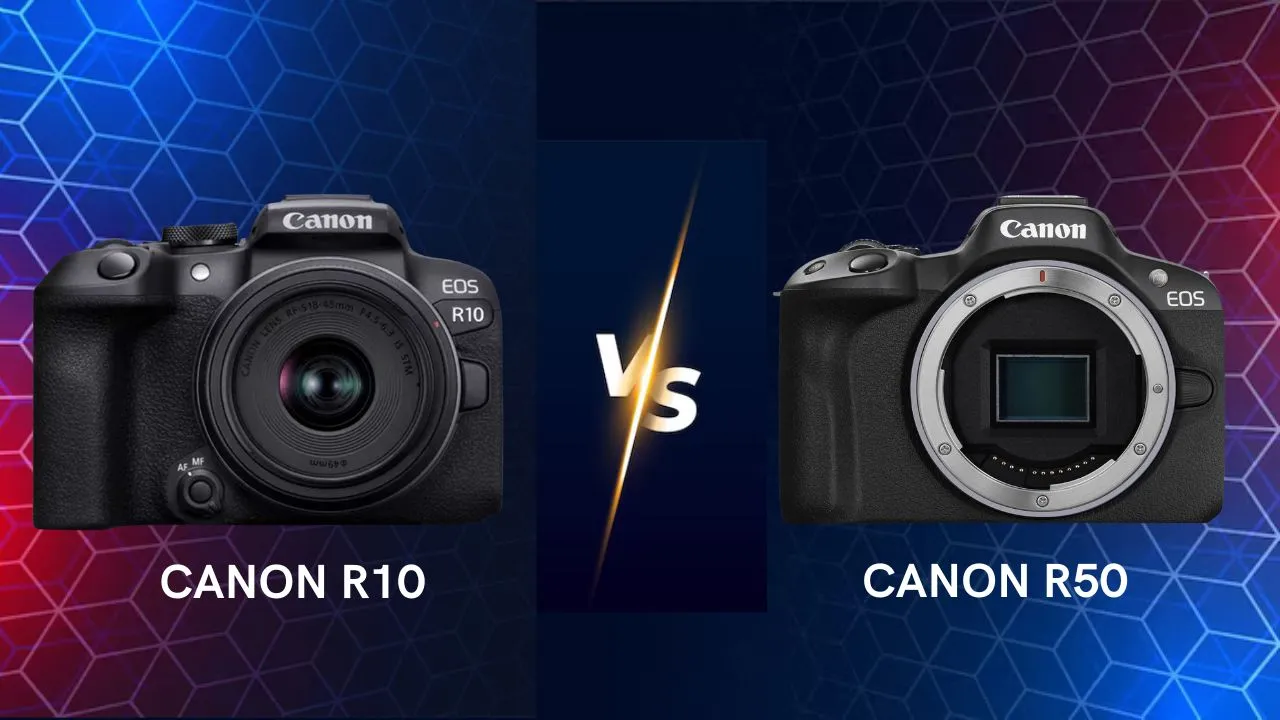
The Canon EOS R10 and Canon R50 are two of Canon’s most popular entry-level mirrorless cameras, both offering fantastic value for beginners and hybrid shooters.
But which one should you buy — the more advanced R10, or the compact and affordable R50?
Let’s dive into a detailed comparison of design, performance, autofocus, video, and value to help you decide which camera fits your needs best.
⚙️ Overview: Two Entry-Level Cameras, Two Different Goals
Both cameras use Canon’s RF mount and 24.2MP APS-C sensor, but they target different users:
-
🎓 Canon R50: Beginner-friendly, lightweight, and budget-oriented.
-
🎥 Canon R10: Geared toward enthusiasts who want more manual control, faster burst speeds, and better ergonomics.
Essentially, the R50 is a smartphone-to-camera upgrade, while the R10 is a true hybrid for photographers and videographers on a budget.
📸 Specifications Comparison
| Feature | Canon EOS R10 | Canon EOS R50 |
|---|---|---|
| Release Date | May 2022 | February 2023 |
| Camera Type | Mirrorless (Hybrid APS-C) | Mirrorless (Entry-level APS-C) |
| Sensor | APS-C 24.2 MP CMOS | APS-C 24.2 MP CMOS |
| Image Processor | DIGIC X | DIGIC X |
| Lens Mount | Canon RF / RF-S | Canon RF / RF-S |
| ISO Range | 100–32,000 (expandable to 51,200) | 100–32,000 (expandable to 51,200) |
| In-Body Image Stabilization (IBIS) | No | No |
| Autofocus System | Dual Pixel CMOS AF II (651 zones) | Dual Pixel CMOS AF II (651 zones) |
| AF Subject Recognition | Humans, animals, birds, vehicles | Humans, animals, birds |
| Continuous Shooting Speed | 15 fps (mechanical), 23 fps (electronic) | 12 fps (electronic), 15 fps (electronic shutter) |
| Video Recording | Up to 4K 60p (oversampled from 6K at 30p) | Up to 4K 30p (oversampled from 6K) |
| Video Bit Depth / Color | 10-bit via HDMI, 8-bit internal | 10-bit via HDMI, 8-bit internal |
| Color Profiles | Canon Log 3 (via HDMI), HDR PQ | Canon Log 3 (via HDMI), HDR PQ |
| RAW Video Output | No | No |
| Recording Limit | No recording limit (thermal dependent) | No recording limit (thermal dependent) |
| Viewfinder | 2.36M-dot OLED EVF | None |
| LCD Screen | 3.0″ fully articulating touchscreen (1.62M dots) | 3.0″ fully articulating touchscreen (1.62M dots) |
| Touch Functions | Yes (AF, tracking, menus) | Yes (AF, tracking, menus) |
| Product Showcase Mode | No | No |
| Background Defocus Button | No | No |
| Body Material | Polycarbonate / magnesium chassis | Polycarbonate |
| Weather Sealing | No | No |
| Audio Options | Mic input | Mic input |
| Connectivity | Wi-Fi, Bluetooth, USB-C, HDMI | Wi-Fi, Bluetooth, USB-C, HDMI |
| Battery Type | LP-E17 | LP-E17 |
| Battery Life (CIPA) | Approx. 430 shots | Approx. 440 shots |
| Dimensions (W × H × D) | 122.5 × 87.8 × 83.4 mm | 116.3 × 85.5 × 68.8 mm |
| Weight (Body Only) | Approx. 382 g | Approx. 329 g |
| Price (Body Only) | Approx. USD 980 (Check on Amazon) | Approx. USD 680 (Check on Amazon) |
🧱 Build and Design
Both cameras share Canon’s familiar modern design, but the R10 feels more robust.
It features a dedicated mode dial, extra control wheel, and a deeper grip, making it more comfortable for long photo sessions or video work.
The R50, on the other hand, is noticeably smaller and lighter — ideal for travel, vlogging, or anyone who wants a simple camera that fits easily into a bag.
👉 Verdict:
-
For comfort and control, go with the R10.
-
For portability and simplicity, the R50 wins.
🎯 Autofocus and Speed
Both models use Canon’s impressive Dual Pixel CMOS AF II system, powered by the same DIGIC X processor found in higher-end cameras like the Canon R6 Mark II.
They share:
-
Subject detection for people, animals, and vehicles
-
Real-time eye and face tracking
-
Fast, reliable focus in both photo and video modes
However, the R10’s faster burst rate (15 fps mechanical) gives it an edge for sports or wildlife photography.
The R50 tops out at 12 fps with the electronic shutter and has a smaller buffer.
👉 Verdict:
If you shoot fast-moving subjects, the R10 is the clear winner.
🎥 Video Capabilities
Both cameras offer strong video performance for their price class:
-
The R50 records 4K 30p from 6K oversampling, giving crisp, detailed footage with no crop.
-
The R10 can shoot 4K 60p, though with a 1.6x crop, meaning your frame becomes tighter.
The R10 also has:
-
Longer recording limits
-
Advanced controls (zebra patterns, custom picture profiles)
-
Better rolling shutter performance
Neither camera features in-body image stabilization (IBIS), so using a lens with optical stabilization (IS) is recommended for smooth handheld footage.
👉 Verdict:
-
For casual 4K video and vlogging → R50 (no crop, simple setup)
-
For flexibility and creative control → R10
📸 Image Quality
Both cameras share the same sensor and processor, meaning image quality is virtually identical.
You’ll get:
-
24MP resolution
-
Excellent color science and dynamic range
-
Clean results up to ISO 6400 (usable to ISO 12,800)
JPEGs straight out of camera have Canon’s signature warmth and natural skin tones.
👉 Verdict:
Tie — both deliver excellent image quality for their class.
🔋 Battery Life and Connectivity
The R10 offers slightly better battery life (around 430 shots) compared to the R50’s 370.
Both charge via USB-C and include Wi-Fi + Bluetooth for easy smartphone pairing and remote control.
If you often shoot while traveling, the R10’s endurance is a small but useful advantage.
💰 Price and Value
At launch, there’s typically about a $300 difference between the two models, which can easily cover a good starter lens or accessories.
👉 If you’re a beginner or casual creator, the R50 offers outstanding value.
👉 If you want speed, control, and room to grow, the R10 is worth the extra investment.
Check availability and price on Amazon 🛒
📷 Canon R50 — Amazon USA / Amazon Canada / Amazon UK / Amazon Australia
📷 Canon R10 — Amazon USA / Amazon Canada / Amazon UK / Amazon Australia
Note: camerafight.com participates in the Amazon Associates Program. As an Amazon Associate, we earn from qualifying purchases.
🏁 Final Verdict – Which One Should You Buy?
| Type of User | Recommended Camera |
|---|---|
| Complete beginner / smartphone upgrader | Canon R50 |
| Travel and everyday use | Canon R50 |
| Enthusiast photographer | Canon R10 |
| Sports and wildlife shooter | Canon R10 |
| Advanced video user | Canon R10 |
| Best price-to-performance ratio | Canon R50 |
✅ In short:
-
Choose the Canon R50 if you want an easy-to-use, compact, and affordable camera for everyday photography or travel.
-
Choose the Canon R10 if you need more speed, controls, and flexibility for both stills and video.
🧠 Final Thoughts
The Canon EOS R10 and Canon R50 are both excellent APS-C mirrorless cameras that share the same imaging pipeline but differ in handling and ambition.
The R10 offers faster performance and deeper control, while the R50 focuses on simplicity and portability.
Whichever you choose, you’ll get Canon’s excellent autofocus system, pleasing color science, and access to the growing RF lens ecosystem — making both cameras fantastic long-term investments.
Also on camerafight: